

5 "Children's" Books EVERYONE Needs to Reread

Why did we ever stop reading children's literature?
If you're anything like me, you haven't stopped watching children's media. There's even a genre of movies created to be enjoyed by the whole family! Why isn't there a genre like that for written publications?
Well, there is. . . We just don't utilize it enough anymore.

A Quick History
"Children's Literature" wasn't quite a thing until the Renaissance and the advent of movable print. Before then, children consumed the same entertainment adults did, if not, simply redacted. Even when it became a thing, it took a much different form: dark stories intended only to instill the adults' worldview in the reader through fear. Enjoyable children's literature finally arrived from the late 1600s to the mid-1700s with the age of philosophy. It came in the form of "games, fables, alphabet books, nursery rhymes, poetry, and fairy tales"(The History of Children’s Literature).
Before the widespread adoption of radio and subsequently, television, in the 1900s, families often read aloud together as a form of evening entertainment. Children's books like Little Women, The Railway Children, and Anne of Green Gables(to name a few that I don't mention in the list but would love to eventually) were particularly popular.

The Current Dilemma
Now, only a much smaller portion of parents are reading aloud to their children at all. According to Shyla Watson, a writer for People Today, "A study shows only 41% of kids aged 0–4 are read to frequently, down from 64% in 2012"(Fewer Parents Read Aloud to Their Children...). That means the percentage of young children being read to frequently has gone down 23% in only 14 years!
It also means adults are less likely to be reading children's books at all, let alone a full-length children's novel. So, let me put you onto a few benefits of reading in this genre before we lose the art completely:
Increased Whimsy: Adult fiction asks a lot of us, and sometimes too much. Often, I miss fairy tales with unexplained magic, rash decisions, and timeless creatures.
Greater Understanding: The human condition will forever be most obvious in children. If you want a reminder of how humans function without the conditioning you have simply because you've lived longer, read children's literature.
Greater Empathy: Children's literature was often meant to teach empathy, allowing children to walk alongside characters unlike them, and yet so very similar to them at the same time. It can do that for you too.
Less Stress: No one's going to pressure you to finish these books, because they're meant to be taken slowly and fully enjoyed. Plus, you genuinely won't have to try that hard to understand anything, because they are literally written for kids!
So let's get on to the first book!
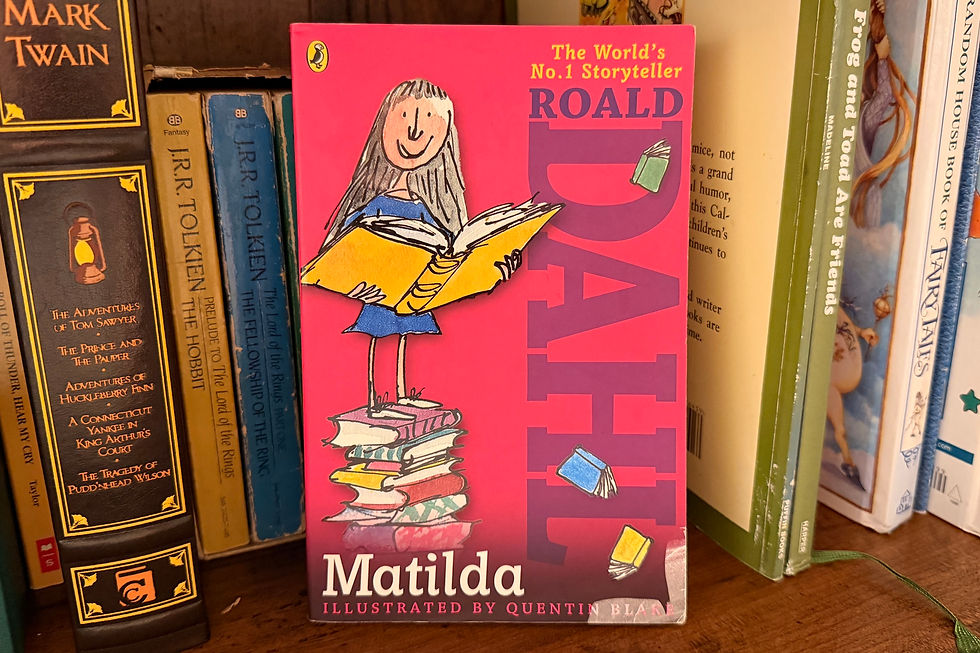
Matilda by Roald Dahl
“All the reading she had done had given her a view of life that they had never seen.” -Matilda, Roald Dahl
Matilda by Roald Dahl was a major turning point for 8-year-old Jade. In my post two weeks ago, "Reading With Our Brains Turned On," I mentioned this transition, saying, "I had just been through an intense period of hardship at home, and seeing Matilda as a reflection of myself, I adopted her escape method: books."
Like Matilda, I grew up in a chaotic household, in which my emotions and thoughts weren't exactly the first priority. Also like Matilda, I was learning to read at just three, and often I felt underestimated by adults. I was immediately engrossed in the story, knowing I'd finally have a strategy for surviving my harsh environment. And there it was: escape mentally when you can't physically, develop independence, and think creatively to stand up to bullies.
I carried these coping mechanisms with me my entire childhood. In fact, I'm convinced it's how I survived it. As a child of abuse and neglect, this book might have been my saving grace, and not only will I recommend it to children, always, I will also recommend it to adults.
We all need a reminder that kids are more intelligent and empathetic- and can be so much more- than we give them credit for. Another book that does this for an adult audience is Ender's Game, though Ender is genetically selected to be that smart, and I don't think it gets the point across quite as well as Matilda. Something Roald Dahl said that really illustrates how intentionally he depicted children is this: "I am totally convinced that most grown-ups have completely forgotten what it is like to be a child between the ages of five and ten. … I can remember exactly what it was like. I am certain I can."

Island of the Blue Dolphins by Scott O’Dell
“The Island of the Blue Dolphins was my home; I had no other. It would be my home until the white men returned in their ship. But even if they came soon, before next summer, I could not live without a roof or a place to store my food.” -The Island of the Blue Dolphins, Scott O’Dell
Many of us read this book in elementary school, and it holds a special place in my heart. However, there is a disclaimer: I don't think it should continue to be read in school. The depictions aren't accurate to the true story or to the Nicoleño tribe's culture, and it should be treated as quality fiction rather than a historically accurate viewpoint.
This book shines as a moving story about resilience, self-reliance, and humanity's innate connection to the natural world. As a society, I think we're slowly losing those qualities, and it's heartbreaking. If you're feeling downtrodden, helpless, or lonely, reread this book, and I guarantee you will be inspired to move in ways you didn't know you could.

Little House in the Big Woods by Laura Ingalls
“She thought to herself, ‘This is now.’ She was glad that the cozy house, and Pa and Ma and the firelight and the music, were now. They could not be forgotten, she thought, because now is now. It can never be a long time ago.” -Little House in the Big Woods, Laura Ingalls
The Little House on the Prairie books weren't formative in my childhood, because I didn't start reading them until eighth grade. But for a lot of you, they were! And I'm so glad they were, because the themes are so simple, yet so powerful: contentment, hard work, family unity.
These are values I still struggle to uphold as an adult. I continue to want more from life, regardless of how good I have it. I do everything I can to work less and lounge more. And when a family member crosses me, I wish I would immediately seek to reconcile, but I don't. These particular lessons are ones we will have to learn over and over again, and what better way than to go back to our childhood, when learning was a wonder.

The Secret Garden by Frances Hodgson Burnett
“ ‘Of course there must be lots of Magic in the world,’ he said wisely one day, ‘but people don't know what it is like or how to make it. Perhaps the beginning is just to say nice things are going to happen until you make them happen.’ ” -The Secret Garden, Frances Hodgson Burnett
The Secret Garden, along with The Little Princess by the same author, are considered classics for a reason. France’s Hodgson Burnett was able to merge realistic struggle while still teaching children about emotional resilience and hope. The Secret Garden, in particular, explored the idea of mind over matter and the importance of friendship.
The simple claim that you can change your circumstances just by changing your mindset is so powerful. And it’s deeply impactful to me, as someone with who deals with chronic pain due to EDS. Not to mention, friendship in hard times makes all the difference, and Burnett depicts this beautifully with Mary, Collin, Dickon, and Marla.
I wish I could say this book’s themes are perfect, but unfortunately, Burnett- a British woman- does unnecessarily criticize foreign nations and the “health risks” associated with them throughout the story. Lucky for us, this isn’t a topic she deeply explores.

The Adventures of Tom Sawyer by Mark Twain
“He had discovered a great law of human action, without knowing it -- namely, that in order to make a man or a boy covet a thing, it is only necessary to make the thing difficult to attain.” -The Adventures of Tom Sawyer, Mark Twain
Mark Twain wove a story masterfully, despite significant backlash(deserved) due to his insensitive depiction of slavery and stereotypical depiction of a Native American character.
Besides that significant caveat to keep in consideration, The Adventures of Tom Sawyer provides examples and a deep analysis of what it means to mature, the hypocrisy of adults in comparison to children, and the power of imagination.
Maturity changes in meaning all the time, but Mark Twain hits it out of the park by pinpointing the universal growth needed for it: growing conscience and responsibility. Adult hypocrisy is also a very important theme, particularly for parents. We try to teach our children about morals, then turn around to do the exact things we tell them not to. Why would Tom listen if no one is actually doing what they say to do? And finally: imagination. It’s akin to Mary Poppins’ “A Spoonfull of Sugar;” Mark Twain argues through narrative that ordinary life should always be an adventure, via your cognitive creativity.

Conclusion
The main idea I want you to get from this is that children’s literature is for everyone! No matter the age, you can enjoy and learn from any literature, given it’s well written and your cup of tea.

Comments